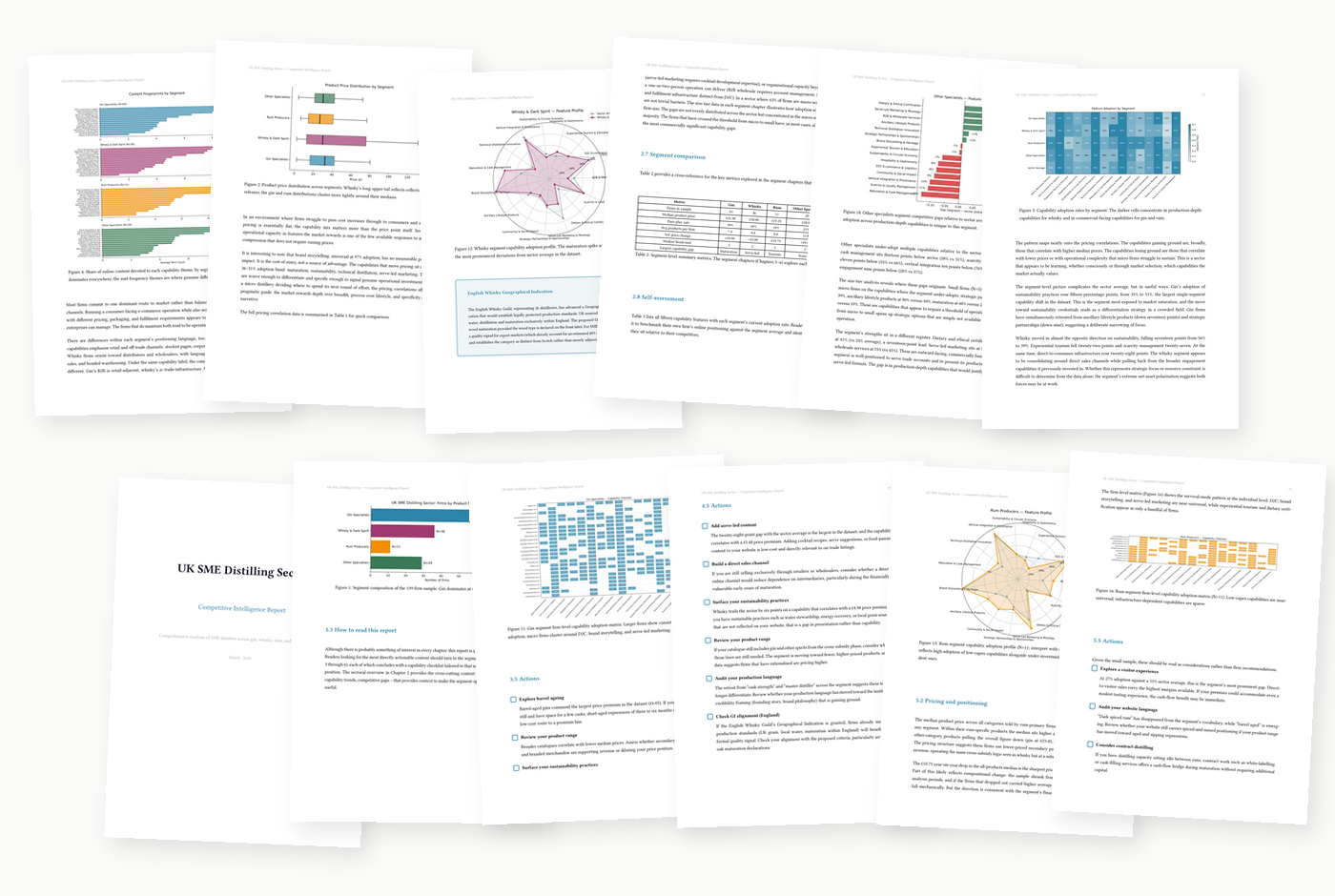
52 pages. 4 segment deep dives. 15 capabilities ranked by price impact. Year-on-year vocabulary shifts. Actionable checklists for every segment.
52 pages of competitive intelligence on the UK SME distilling sector. Which capabilities correlate with £5-6 more per bottle. Which popular investments have negative price correlations. What AI search tools are reading on your website. Where the gaps are in your segment that nobody's filled yet. All broken down by gin, whisky, rum, and specialist spirits.
30-day money-back guarantee. If you don't think the report is useful, I'll refund you in full.
52 pages. 4 segment deep dives. 15 capabilities ranked by price impact. Year-on-year vocabulary shifts. Actionable checklists for every segment.
Diageo spends six figures a year on market intelligence. They know which capabilities drive pricing power, where the gaps are, and how the landscape is shifting. You're making the same kinds of decisions, often with more at stake relative to your size, but without any of that data.
That's always been an issue, but now it's getting worse. Consumers are pickier about premium purchases than they were two years ago. And AI search ChatGPT, Google’s AI Overviews, Perplexity is changing how people discover brands. These tools read your website, interpret what you actually do, and decide whether to recommend you. If your positioning sounds like everyone else in your segment, you're invisible to them.
I wrote this report to put SME distillers on a level playing field. I run a small UK data company with over a decade's experience in this kind of analysis, and I'm confident enough in the value to offer a full money-back guarantee.
Less than the cost of a case of spirits. Genuinely useful or your money back.
If even one finding changes how you invest, price, or position your distillery, it'll have paid for itself many times over. If it doesn't, just email me within 30 days for a full refund. No quibbling.
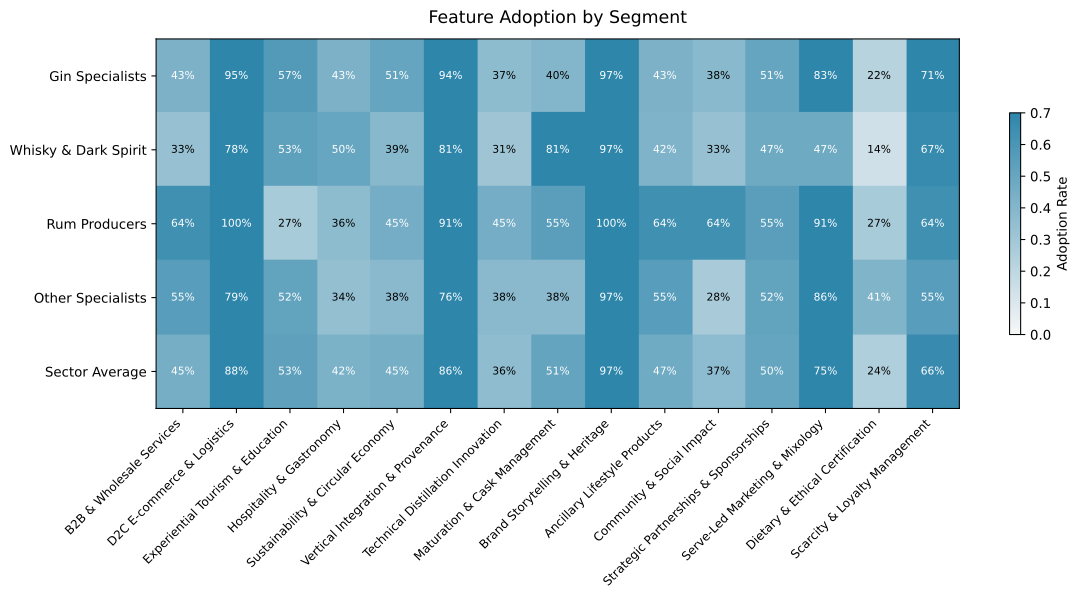
Get the reportOne capability that 60% of gin producers haven't adopted correlates with a clear price premium and takes as little as 3-6 months to add. That's one finding. The report is full of them, each backed by data from a wide range of gin producers.
The largest competitive gap in the entire dataset belongs to whisky. Over half the segment hasn't adopted a capability that correlates with a £5+ premium and it costs almost nothing to add. The report covers this and every other lever, specific to whisky, from 36 producers.
One of the highest-margin channels in craft distilling (direct sales) is used by barely a quarter of rum producers. Your segment has the thinnest balance sheets in the industry. The report shows which investments make sense when cash is tight.
Specialist producers carry 60% more products than gin producers and are charging less per bottle. Whisky producers are doing the opposite: cutting range and raising prices. Which approach works? The report puts numbers on the trade-off looking at producers across liqueurs, brandy, vodka and more.
I'm very confident that one good decision will repay the cost of this report many times over. If it's not useful, you pay nothing.
52 pages of competitive intelligence, specific to your segment. 30-day money-back guarantee.
Get the report